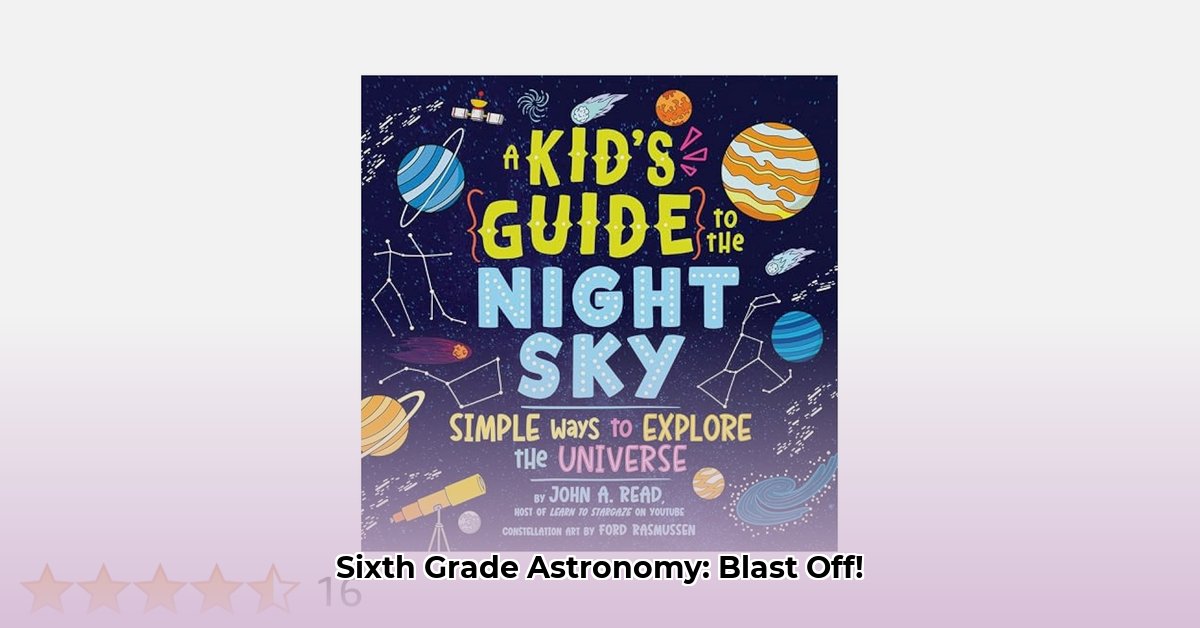
Sixth Grade Astronomy Guide: Blast Off to Fun Learning!
Hey there, future astronomers! Ready for an awesome journey through space and beyond? This guide isn't just about memorizing facts; it's about doing science, having fun, and discovering the incredible wonders of the universe! We'll explore the solar system, the moon's phases, constellations, and even touch upon the amazing world of cells – all with super cool hands-on activities. Did you know that hands-on activities increase knowledge retention by up to 90%? For even more information on stars, check out this great resource: Learn more about stars. Let's get started!
Mapping Our Cosmic Neighborhood: A Solar System Scale Model
Ever looked up at the night sky and wondered about the vast distances between planets? Let's build a scale model to make those distances more understandable. This is like creating a mini-universe in your classroom!
Materials:
- Long measuring tape
- Colorful markers
- Small balls or beads (representing planets)
- String or yarn
Instructions:
- Choose a Scale: Let's say 1 inch represents 10 million kilometers (adjust as needed).
- Measure and Mark: Measure the distances between the sun and each planet using your chosen scale. You can find this data online or in a science textbook.
- Place Your Planets: Attach your planet "balls" to the yarn at the measured distances, labeling each with its name.
Discussion: What's most surprising about the distances between planets? How does this change your perception of the solar system's size?
Moon Phases: A Mystery Solved!
Why does the moon seem to change shape? It's all about light and shadows! Let's create a mini-moon to figure it out.
Materials:
- Styrofoam ball (moon)
- Bright flashlight (sun)
- Dark room
Instructions:
- Sunlight Showdown: Hold the Styrofoam ball in front of the flashlight.
- Slow Rotation: Slowly turn the ball. Observe how the lit portion changes. This demonstrates the moon's phases.
Discussion: Which side of the "moon" always faces the "sun"? Why do we only see a portion of the lit side from Earth?
Constellation Creators: Designing Your Own Star Patterns!
Constellations are like giant connect-the-dots in the night sky! Let's create our own.
Materials:
- Black construction paper
- Star stickers or glitter glue
- Constellation reference images (online or books)
Instructions:
- Pick a Constellation: Choose a constellation you like.
- Draw and Decorate: Draw the constellation and add your stars.
- Share Your Stories: Create your own mythology or story about your constellation.
Gravity's Great Game: A Marble Race!
Gravity keeps us grounded and planets orbiting the sun. Let's test it with a fun marble race!
Materials:
- Inclined ramp (board propped up)
- Marbles of different sizes
- Stopwatch
Instructions:
- Set up the race: Place marbles at the top of the ramp.
- Time the race: Release marbles and time them.
- Analyze: Compare times for different-sized marbles. What does this show about gravity's effect on size?
The Amazing World of Cells: A 3D Model
Cells are the tiny building blocks of life! Let's build a 3D model.
Materials:
- Modeling clay (different colors)
- Toothpicks
Instructions:
- Cell Research: Research the main parts of a cell (nucleus, cell membrane, mitochondria).
- Clay Creation: Shape each part using clay and connect them with toothpicks. Add labels!
Discussion: How do the cell parts work together? How would the cell be different without one part?
Taking It Further: More Awesome Astronomy and Biology Adventures!
Want more? Try these:
- Create a Planet Profile: Research a planet and create a presentation.
- Build a Water Cycle Model: Show how water cycles between sky, land, and sea.
- Stargazing Trip: Identify constellations with a grown-up.
Remember, the universe is vast and incredible! Keep exploring and having fun!